Within The Home Depot, there is a large contingency of eco-conscious associates. They call themselves the Sustainability Squad, and they are living proof that Eco Actions make a difference. They are living a DIY sustainability lifestyle. Each month, we sit down with members of the Sustainability Squad to learn more about their inspiration and motivation and the individual Eco Actions.
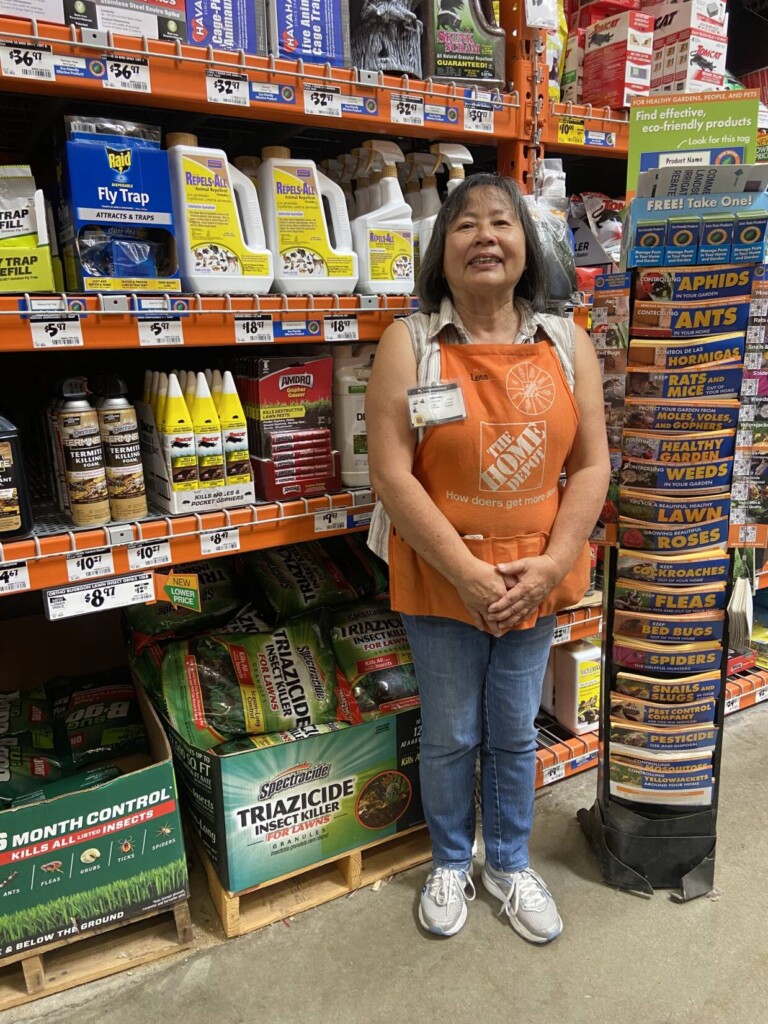
This month, we sat down with Lena Medina. Based at Store 6604 in San Ramon, CA, Lena has been a garden associate since 1997. In these 26 years, she’s had extensive experience with the local Our Water Our World program, learning more about how to keep pests at bay while avoiding harmful chemicals that may have adverse effects on local waterways. (Check out our interview with OWOW’s program coordinator here.) Lena has helped guide and educate countless other Home Depot store associates and customers, and agreed to sit down with us and share what she’s learned.
 EA: Good day, Lena. How are you today?
LM: I’m well, thank you.
EA: How were you introduced to Our Water Our World (OWOW)?
LM: A good while ago, Our Water Our World reached out to Home Depot. Their purpose was to collaborate on community engagement and educating both store associates and customers about ways to handle pests with organic chemicals or avoiding chemicals altogether. My role was to organize the various training sessions they conducted. They focus on advocating for maintaining clean waterways, free from traditional pesticides and chemicals. They also endorse organic fertilizers and non-chemical methods for controlling pests and weeds, all of which I help in sharing with associates and our customers. Their goal is to educate and create awareness so customers can make informed decisions about the products they use. I ensure that information is readily available to those who seek it, whether associates or customers, and I align their efforts with our Kids Workshops to maximize outreach.
EA: How have their principles impacted your garden management approach? Have you incorporated any practices personally thanks to Our Water Our World?
LM: Their training empowers us to effectively communicate environmentally preferred gardening practices. In my own garden, I integrate several practices that they advocate for, like using vinegar to eliminate weeds, baits for insect control, and diatomaceous earth for barrier treatments.
EA: How have you seen customers respond to these ideas? Do they ask many questions or ask for more information?
LM: When customers ask questions, Our Water Our World teaches us to provide informed responses and help customers know all their options, including more environmentally mindful things they might not typically think of. Our role is to facilitate access to information. We also direct customers to our information kiosk that has lots of info sheets that customers can take home. OWOW also tags approved products on our shelves, which helps customers see which products are environmentally preferred.
EA: What techniques promoted by OWOW most surprise customers?
LM: Techniques like using vinegar or diatomaceous earth to combat weeds or controlling pests with natural alternatives rather than chemicals stand out. Customers sometimes express surprise at simple remedies like sprinkling a little baking soda on the soil around plants to eliminate fungus gnats. It’s nontoxic and easy to find around the house. Soap spray is also an easy way to keep bugs such as aphids away. If your roses have black spot, powdery mildew or aphids, I advise watering by drip instead of sprinkle, keeping detritus cleaned up around the plants, using a sharp stream of water to knock down the aphids, or soap spray. But not all bugs are bad. We encourage the presence of beneficials, or ‘good bugs’, which can help control the spread of pests.
EA: Speaking of pest control, what are some of the most common concerns among customers where you often recommend Our Water Our World-approved solutions?
LM: Pest control is a very common issue. A lot of customers have problems with raccoons, skunks, and rodents. Our Water Our World methods look at the root cause so the solution is sustainable. So, in the case of these kinds of pests, we recommend closing up any points of entry and using repellent to keep the animals at bay. You can also remove their food sources or use humane traps. That’s one of the big benefits of the program – OWOW teaches how to address the root cause instead of having to solve the same problem over and over again.
EA: Looking ahead, what do you envision for the future of Our Water Our World?
LM: Our store management has supported our OWOW efforts, which I really appreciate, and they hope to see continued engagement.
EA: Excellent. Thank you for sharing your insights and experiences, Lena!
LM: You’re welcome.